What BigQuery tells you that GA4 can’t
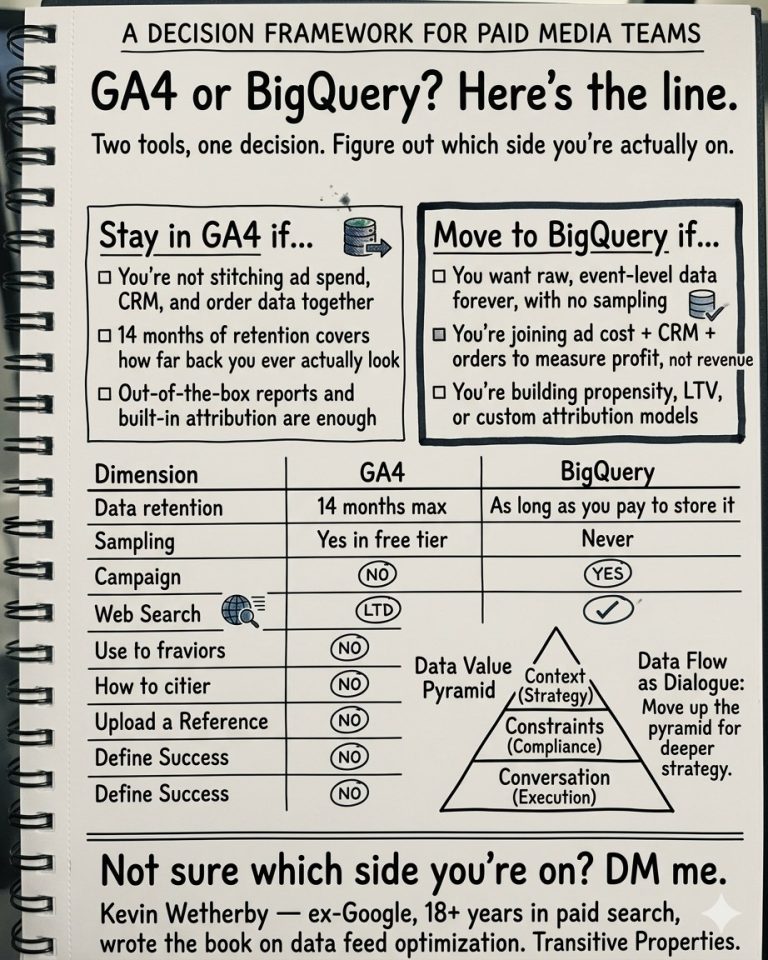
GA4 answers the questions Google decided to pre-build reports for. That’s a useful list, but it’s a small list once you start running real money through paid media.
Below are six questions I get asked all the time by clients spending $3-50K/month in Google Ads. None of them can be answered in the GA4 UI alone. All of them are routine in BigQuery once you have the export running.
I’ve spent 18 years in paid search and time at Google. These are questions worth knowing the answers to before you commit to scaling spend.
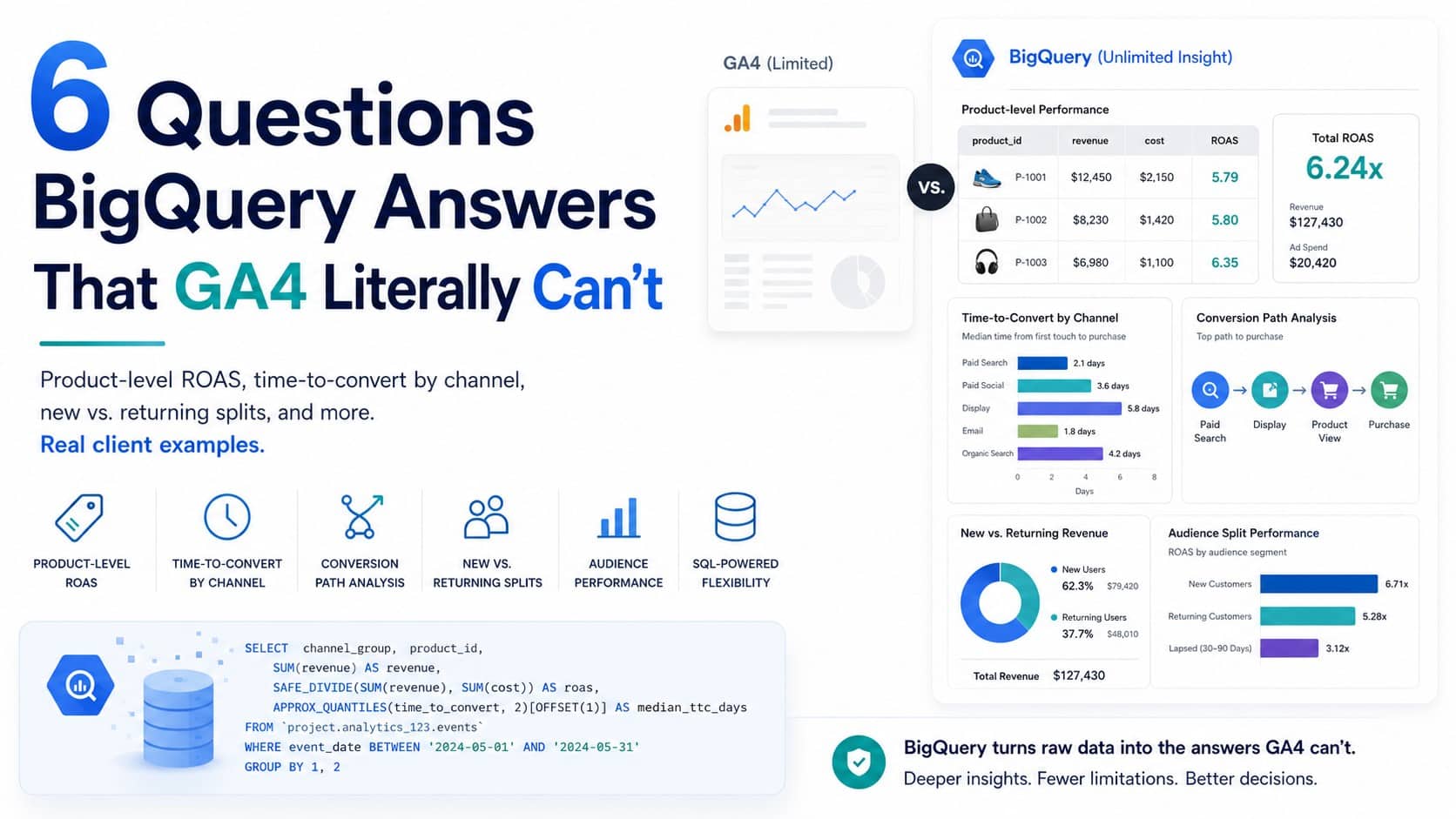
1. Which products are profitable, not just high-revenue?
GA4 will tell you that Product A drove $40K in revenue last month. It won’t tell you that Product A also consumed $35K in ad spend through Shopping and PMax, while Product B drove $12K in revenue on $1K in spend.
In BigQuery, you join items from your GA4 export to a Google Ads cost table (uploaded daily or queried via the Google Ads Data Transfer) and group by SKU. The query is maybe 30 lines. The output reorders your “winners” list completely.
2. How long does a visitor actually take to convert, by channel?
GA4 has a conversion-paths report, but it’s sampled, thresholded, and not channel-specific in a useful way.
A simple BigQuery query measures the gap between first session and conversion event for every converting user, then groups by first-touch channel. One client found:
- Paid search first-touch: median 2 days
- Paid social first-touch: median 14 days
- Organic first-touch: median 21 days
That single chart changed how they evaluated paid social ROAS. Reported numbers had been ranking it near the bottom; once they accounted for the time-to-convert gap, paid social was actually their second most efficient channel.
3. What percent of your conversions are new vs. returning customers?
GA4 has a “new vs returning” dimension. It’s based on cookies and gets nuked every time a Safari user clears their browsing data, which is most Safari users.
In BigQuery, you can join user_pseudo_id to a customer table (CRM, Shopify, whatever you have) and segment conversions by actual customer status. New-customer ROAS and repeat-customer ROAS often look completely different. You probably want to bid differently for each.
4. If you paused your top 3 campaigns tomorrow, how much revenue would actually disappear?
This is the incrementality question and it’s the hardest one to answer with platform data, because the platform reports the credit it took for the conversion, not whether the conversion would have happened anyway.
BigQuery doesn’t fully solve this either, but it gets you closer. You can build cohort-based comparisons (similar customers exposed vs. not exposed), compare conversion rates across geo-tests, and reconcile against organic baselines. Real incrementality testing is a separate workstream, but BigQuery is where you stage the data for it.
5. Which Shopping query terms are wasting money?
Google Ads gives you search terms reports. They’re useful but they aggregate at the campaign or ad-group level.
In BigQuery, with the Google Ads Data Transfer running, you can join search terms to actual revenue from the GA4 export at the SKU level. You’ll find queries that look like winners by click-through rate but never produced a sale of the product they appeared on. Negative those, save the spend, move on.
6. What does a real custom audience look like?
GA4 audience builder has limits: number of conditions, lookback windows, available dimensions. If you want to build “users who viewed Product A, didn’t view Product B, visited 3+ times in 14 days, and have an above-median session duration,” you’re going to hit a wall in the GA4 UI.
In BigQuery, that’s a SQL query. You materialize the user list and feed it back to Google Ads as a customer match audience. Bid more aggressively on it.
When you don’t need any of this
If your business runs on a single product, sells to first-time visitors in one session, spends under $10K/month on ads, and the GA4 audience builder gives you what you need, you don’t need BigQuery. The cost of setup, query time, and someone on your team capable of writing SQL outweighs the upside.
The break-even point is somewhere around $15-20K+/month in spend for most ecommerce businesses. Below that, the GA4 UI is doing more for you than it gets credit for. Above it, you’re flying with a partial picture.
If any of those six questions sound familiar
I build the answers to these questions as standard work for clients on retainer: BigQuery setup, GA4 export, query library, and reporting that surfaces the answers monthly so you don’t have to ask.