Data Feed Optimization
By Kevin Wetherby. Ex-Google, 19+ years in paid search, author of Feed Your Business – Secrets From A Google Insider
Data feed optimization for Google Shopping and Performance Max
Your feed is the campaign
No pitch. I’ll open your account, tell you what’s leaking, and send you the notes.
If you’re running Shopping or PMax and performance is flat, the feed is usually where I find the problem. Bid strategy, structure, budgets, those are the easy levers to blame. The feed is where the damage actually lives.
A quick disclosure before I keep going. I’m Kevin Wetherby. I spent 19 years in paid search, including time at Google, and I wrote a book on data feed optimization. I’ve audited a lot of feeds. The patterns repeat.
Here’s what I see most weeks. A brand pays a good agency. Campaign structure is fine. Bidding is reasonable. But the feed is doing maybe 40% of the job it could be doing. Titles read like a SKU list. Half the attributes are blank. Custom labels don’t exist. Merchant Center is throwing soft warnings nobody has read in months.
You probably need a feed audit before you need anything else.
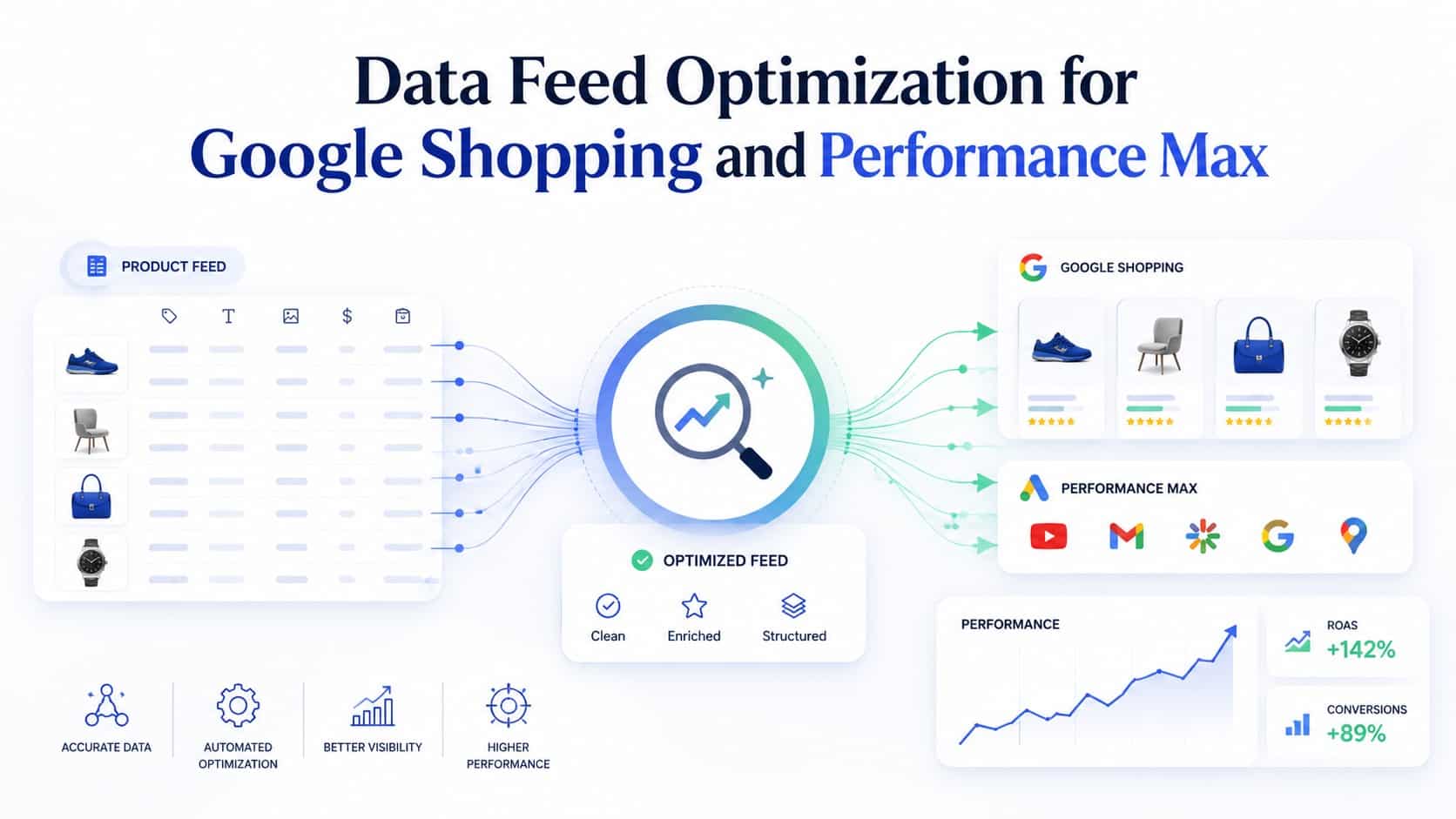
What the feed actually controls
Most advertisers think of the feed as a product list. That’s wrong, and it’s expensive.
The feed controls three things bidding cannot fix:
- Which queries you show up for. Google reads your titles, descriptions, GTINs, and product types to decide what searches match your products. Generic titles get generic queries, and generic queries lose.
- How relevant you look. Title quality, image quality, price competitiveness, and shipping signals all feed into how Google ranks you against everyone else in the auction.
- How smart bidding can segment you. Without good attributes and custom labels, the model treats your bestseller and your slow mover identically.
The feed is upstream of everything you can change in the campaign UI. Fix the feed, and the same bids work harder.
The four areas where feed work pays back
I keep coming back to the same four. They map to the five articles below.
1. Product titles
Titles are the highest-impact field in the feed. They drive query matching, click-through rate, and how Google understands your products. Most brands ship the manufacturer’s title and forget it exists. The top 10% rewrite titles to lead with the attributes buyers actually search for. The gap shows up in performance.
Read: Product titles in Shopping: what the top 10% of advertisers do differently
2. Attributes that matter (and the ones that don’t)
GTIN, brand, product type, color, size, gender, age group, material, pattern, item group ID. Some of these move performance. Some are cosmetic. Some are required just to keep your products approved. Knowing which is which keeps you from spending three weeks fixing a field nobody cares about.
Read: Feed attributes that move Shopping performance (and the ones that don’t)
3. Custom labels and price competitiveness
Custom labels are how you tell Smart Bidding what to do. Margin tiers, seasonal tags, price competitiveness flags, inventory depth. Without them, the bidding model has no idea which products to push hard and which to throttle.
Read: Custom labels and price competitiveness: the feed signals most people miss
4. Merchant Center hygiene
Disapprovals, soft warnings, missing required values, account-level issues. Most accounts I open have dozens. Each one shrinks eligible inventory. Each one is fixable in an afternoon.
Read: Common Merchant Center mistakes that quietly kill performance
And before any of that work starts, you audit:
Read: How to audit your Google Shopping feed (the way I actually do it)
How to know if the feed is your problem
A few signals your feed is leaving money on the table:
- Branded queries convert at 10x non-branded, and you can’t scale non-branded
- You have product disapprovals you’ve never investigated
- Your titles haven’t been touched since the manufacturer wrote them
- You can’t tell Smart Bidding which products are high margin
- Impression share on hero products is below 50%
Three of these on your account and a feed audit pays back fast.
When feed work isn’t your problem
I’d rather tell you up front. If any of these are true, feed optimization is the wrong place to start.
You sell 5 SKUs. The math on a feed audit doesn’t work. Focus on landing pages and ad copy.
You sell digital products or services. Shopping isn’t your channel.
Your ROAS target is double what your category can deliver. The feed can’t fix unit economics.
Your conversion tracking is broken. Fixing the feed before the data is clean is painting over rust.
If any of those describe you, save your money.
How I actually run a feed audit
Every audit I do follows the same shape. I’ll cover it in detail in the audit article, but the headline version:
- Pull the feed, join it to the last 90 days of Shopping performance in BigQuery
- Segment by product type, brand, and price band. Find the dead inventory and the hero SKUs
- Read every Merchant Center diagnostic. Especially the account-level issues
- Audit the top 50 revenue-driving titles by hand. Look for missing attributes and weak query matching
- Build a custom label scheme that maps to the bidding strategy
- Write the prioritized fix list with estimated lift
Most audits take 2 to 3 days of focused work. The output is a fix list ranked by expected impact, not a 60-page PDF nobody reads.
What to read next
Start with the audit if you’re new to this. Skip to titles if you’ve done audits before but never seriously rewritten your product names. Read the custom labels piece last, because it builds on everything else.
- How to audit your Google Shopping feed (the way I actually do it)
- Product titles in Shopping: what the top 10% of advertisers do differently
- Feed attributes that move Shopping performance (and the ones that don’t)
- Common Merchant Center mistakes that quietly kill performance
- Custom labels and price competitiveness: the feed signals most people miss
If you want me to run the audit on your account, I take a small number of these per quarter. The waitlist usually has room. Get in touch.
For the broader data and tracking stack that sits underneath all of this, the main pillar is GA4 and BigQuery for Google Ads.
Ready to Talk About Your Account?
I take on a limited number of clients. Book a free 30-minute strategy call to see if we’re a good fit. No sales pitch, just a straight conversation about what’s working, what isn’t, and what I’d do differently.